Bhutan’s traditional dress is one of the most visible expressions of the country’s cultural identity. The gho worn by men and the kira worn by women are much more than distinctive garments: they are part of Bhutan’s living heritage, seen in schools, offices, public life, religious settings, festivals and important family occasions.
For travelers, the first question is often simple: what is the traditional dress of Bhutan called? The answer is gho for men and kira for women. But understanding Bhutanese clothing goes much further. The way the garments are wrapped, fastened and accessorized reflects the country’s textile traditions, etiquette, social context and long history of cultural preservation.
Bhutanese national dress is also closely associated with Driglam Namzha, the traditional code of etiquette and conduct that includes expectations around dress and behavior in formal settings. At the same time, Bhutanese textiles continue to evolve, with younger generations adapting colors, patterns and styling while keeping the essential garments recognizable.
In this guide, Travel Across Bhutan explains the traditional clothing of Bhutan, from the gho and kira to the kabney, rachu, wonju, tego and kera. We will also look at how the clothes are worn, when they are required or appropriate, what they mean, and where travelers can experience Bhutan’s remarkable textile culture.
What Is Bhutan’s Traditional Dress?
The national dress of Bhutan has two principal forms: the gho, the traditional garment worn by men, and the kira, the traditional garment worn by women.
The gho is a wrap-style robe that is folded and fastened around the waist. The kira is a long rectangular textile wrapped around the body and secured at the shoulders and waist. Both garments are normally worn with additional pieces such as belts, blouses, jackets, scarves and traditional footwear.
Official Bhutanese cultural sources describe the gho and kira as important symbols of national identity. The National Museum of Bhutan also explains that women’s kira is secured at the shoulders with brooches and at the waist with a belt, while men’s gho is gathered and fastened with a cloth belt.
So, when someone asks “What is Bhutan’s national costume?”, the most useful answer is not one single garment but an ensemble centered on the gho and kira.
The Gho: Traditional Bhutanese Clothing for Men

The gho is the traditional garment worn by Bhutanese men. It is a long wrap-style robe that is folded and raised around the legs before being secured at the waist with a kera, a woven belt.
Once fastened, the fabric forms a distinctive pocket-like fold across the front. Historically, this space could be useful for carrying small everyday objects, although the practical details of how people use the gho have naturally changed over time.
The garment is commonly made from cotton or wool, with heavier fabrics used in colder conditions. Bhutanese textiles range from relatively simple everyday fabrics to highly intricate handwoven designs, and the choice of material, pattern and finish can vary according to occasion, region and personal preference.
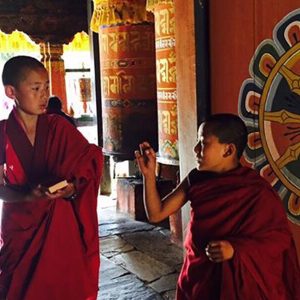
The gho is not simply a costume reserved for performances. Bhutanese men continue to wear it in many formal and public contexts, including schools, workplaces, religious settings and official occasions.
The Kera: The Belt That Secures the Gho
The kera is the woven belt used to secure the gho around the waist. Its practical purpose is essential: without it, the garment cannot be folded and held in the characteristic Bhutanese way.
Keras can also contribute to the appearance of an outfit, particularly when woven from colorful textile patterns. Similar belts are used as part of women’s traditional dress.
The Hemchu: The Folded Pocket of the Gho
The front fold created when the gho is wrapped and belted is often used as a practical storage space. It is one of the garment’s most recognizable features and a good example of how traditional Bhutanese clothing combines appearance with everyday function.
How Is the Gho Worn?
The gho is put on as a wrap rather than as a closed shirt or tunic. The fabric is arranged around the body, raised and folded, then secured with the kera. The sleeves can be adjusted according to the occasion and temperature, while the overall length and finish are arranged to meet the conventions of the setting.
That process is part of what makes the garment distinctive: the same basic piece of cloth can be adjusted for everyday life, work, ceremonies or different weather conditions.
The Kabney: A Scarf with Social Meaning

The kabney is a long ceremonial scarf worn by men with formal versions of the gho. It is draped over the left shoulder and is closely associated with the Bhutanese system of etiquette, rank and official responsibility.
The most familiar distinction is that an ordinary citizen wears a white kabney. Different colors indicate particular official, religious or institutional positions; the system is therefore more nuanced than a simple two- or three-color hierarchy.
For visitors, the important point is that a kabney is not simply a fashionable scarf. Its color and context can communicate status and responsibility, which is why the garment should not be imitated casually as a costume.
The Kira: Traditional Dress for Bhutanese Women
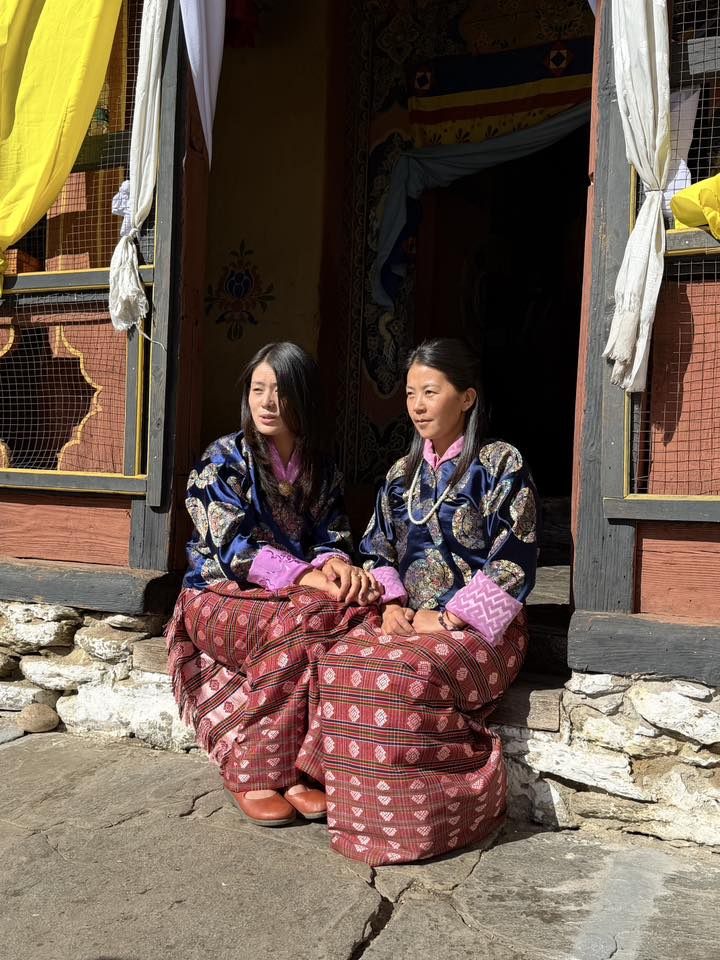
The kira is the principal traditional garment worn by Bhutanese women. It is an ankle-length wrap made from a large rectangular piece of woven fabric.
The textile is wrapped around the body and secured at the shoulders with two decorative brooches, commonly known as koma, then tied at the waist with a kera. A blouse or shirt is worn underneath, while a short jacket is commonly added to complete the ensemble.
The appearance of a kira can vary enormously. Some are relatively simple and understated; others are richly patterned, heavily woven and visually complex. Bhutan’s extraordinary textile traditions mean that fabrics can reveal regional techniques, family craftsmanship and individual taste.
The Wonju
The wonju is the blouse or inner shirt worn underneath the kira. It is generally lighter than the outer textile and creates an additional layer of color and pattern beneath the jacket.
Rather than thinking of the wonju as a separate costume, it is more useful to see it as one component of a layered outfit designed for comfort, modesty and visual balance.
The Tego
The tego is the short jacket worn over the kira. It can be particularly decorative, with contrasting cuffs, woven patterns or embroidery that complement the main textile.
Contemporary Bhutanese women also experiment with the styling of the tego, using modern combinations of colors and fabrics while retaining the recognizable structure of the traditional outfit.
The Kera
The kera holds the kira securely at the waist. Women’s keras can be especially colorful and elaborately woven, making an essential functional element part of the overall visual composition.
The Rachu
The rachu is a ceremonial scarf worn over the shoulder with women’s formal dress. It is often richly embroidered and adds another layer of color and texture to the kira ensemble.
Like the kabney, the rachu is associated with formal and ceremonial contexts. It should therefore be understood as part of Bhutanese etiquette and presentation rather than simply as a decorative accessory.
The Koma Brooches
The two koma brooches used to fasten the kira at the shoulders are both practical and decorative. Traditionally made from metal, they hold the large rectangular textile in place and have become one of the most recognizable details of Bhutanese women’s dress.
Tsholham and Pambas: Traditional Footwear

Tsholham are traditional Bhutanese shoes worn with national dress. They can be made from materials such as leather or cloth and may feature decorative work. Traditional footwear adds the final element to an outfit that is otherwise carefully structured from head to toe.
In colder areas and during winter, warm woolen socks may also be worn. The exact combination depends on climate, activity and occasion.
What Do Gho and Kira Mean to Bhutanese People?
Bhutan’s national dress is closely associated with identity, cultural continuity and national pride. Bhutan’s own educational and cultural materials describe the gho and kira as important symbols that distinguish Bhutanese identity.
But the meaning of the clothing goes beyond national symbolism. Wearing traditional dress connects people with family weaving traditions, regional textile practices, ceremonies, schools and public institutions. A kira can be contemporary and fashionable while still being unmistakably Bhutanese; a gho can be worn for an ordinary working day and still express a strong connection with heritage.
This is why the phrase “traditional dress” can sometimes be misleading. In Bhutan, these garments are traditional, but they are not simply relics of the past. They remain part of contemporary life.
Driglam Namzha and Bhutan’s Dress Code
The relationship between clothing and public life in Bhutan is often discussed through Driglam Namzha, a traditional code of etiquette and conduct. It includes expectations concerning appropriate dress and behavior, particularly in formal settings.
For Bhutanese citizens, traditional dress remains especially important in formal contexts such as government institutions, official events, schools and religious settings. The precise expectations depend on the setting and the person’s role.
Visitors should not confuse Bhutan’s national dress code with a rule requiring tourists to wear a gho or kira. Bhutan’s official tourism FAQ states that there are no specific clothing rules for visitors. However, when entering religious places, respectful smart-casual clothing covering the body from shoulders to knees is appropriate and appreciated.
That distinction is important because some older travel articles still describe the rules for tourists too broadly.
Traditional Dress in Modern Bhutan
Bhutanese clothing is not frozen in a historical image. Contemporary designers and younger Bhutanese often reinterpret traditional textiles through new color combinations, simpler patterns, modern tailoring and different accessories.
Bhutan’s official tourism journal has highlighted this evolution, noting that the gho and kira remain part of daily life while younger people are reinventing the way traditional textiles and garments are styled.
This is particularly visible in Thimphu, where traditional dress can appear alongside contemporary cafés, offices, universities, hotels and shops. The contrast is revealing: cultural continuity does not necessarily mean refusing modernity.
Instead, Bhutanese fashion demonstrates how a tradition can remain recognizable while adapting to changing tastes and lifestyles.
Bhutanese Textiles: The Craft Behind the Clothing
You cannot fully understand traditional Bhutanese clothing without looking at the textiles themselves.
Weaving is an important craft tradition in Bhutan, with distinctive techniques and textile practices associated with different regions and communities. Fabrics can be woven from cotton, wool, silk and other fibers, and the complexity of a textile may reflect the skill, time and technique invested in producing it.
Patterns and colors can vary significantly, and highly elaborate handwoven textiles can represent considerable craftsmanship. The finished garment is therefore not simply clothing purchased as a generic product: it can be the result of many hours of skilled work.
Travelers interested in this side of Bhutan can explore local handicrafts and textile shopping, visit textile-related cultural attractions, or simply pay attention to the fabrics worn in villages and towns.
Regional and Community Variations
There is no single textile look shared identically throughout Bhutan. Different communities have their own weaving traditions, patterns and clothing variations.
The National Museum of Bhutan, for example, displays garments associated with communities such as the Brokpa and the Layap, alongside dance costumes from western and central Bhutan. These regional traditions add another layer to the story of Bhutanese clothing.
This is one reason a visit to a museum or textile center can be so useful: it reveals that “Bhutanese dress” is not a single uniform style, but a broader family of garments and textile traditions.
How to Wear Bhutanese Traditional Dress
There is a practical learning curve to wearing a gho or kira because the garments are wrapped and secured differently from most modern Western clothing.
How to Wear a Gho
- Wrap the robe around the body and arrange the front panels evenly.
- Raise and fold the lower part to create the characteristic knee-length form.
- Adjust the upper fabric and sleeves for comfort.
- Secure the robe firmly with the kera.
- Arrange the front fold or pocket neatly.
- For formal settings, add the appropriate kabney if required by the occasion and status of the wearer.
How to Wear a Kira
- Wrap the large rectangular textile around the body.
- Fasten it at the shoulders with the two koma brooches.
- Secure the wrapped fabric at the waist with the kera.
- Wear the wonju underneath.
- Add the tego as the outer jacket.
- For formal occasions, complete the ensemble with a rachu and suitable footwear.
In practice, learning from someone who wears the garment regularly is much easier than trying to reproduce the wrapping technique from written instructions alone.
When Do Bhutanese People Wear Traditional Dress?
Traditional clothing appears in many parts of Bhutanese public life, but the frequency and context vary.
- Schools: children commonly wear versions of the national dress as part of school life.
- Workplaces: traditional dress is especially visible in government and formal professional settings.
- Religious sites: appropriate traditional and formal clothing reflects respect for sacred spaces.
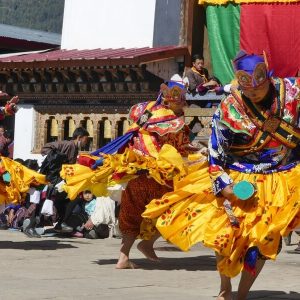
- Festivals: the gho and kira are highly visible during tshechu and other festivals.
- Weddings and ceremonies: formal garments and accessories can form part of important family occasions.
- Daily life: many Bhutanese people continue to wear traditional clothing beyond strictly ceremonial occasions.
The result is unusually visible cultural continuity. A visitor can see the same basic garments in very different environments, from a government office to a monastery courtyard or a village festival.
Can Tourists Wear a Gho or Kira in Bhutan?
Visitors can encounter opportunities to wear or try traditional Bhutanese clothing, particularly during cultural experiences, festivals, photography sessions or events arranged by local hosts. The important principle is respect rather than imitation for its own sake.
A gho or kira should not be treated as a novelty costume. If a local host invites you to wear one, ask how it should be put on and how it should be worn appropriately for the setting.
Most importantly, tourists do not need to wear national dress simply to visit Bhutan. The official tourism guidance specifically distinguishes the dress expectations for Bhutanese citizens from the clothing expected of visitors.
Traditional Dress and Bhutanese Festivals
Festivals are among the best places to see the full visual richness of Bhutanese clothing.
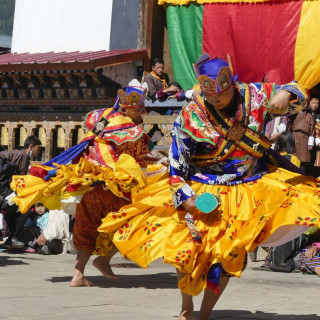
During a major Bhutanese festival, you may see everyday gho and kira worn alongside highly formal garments, ceremonial scarves, elaborate jewelry and specialized dance costumes. The concentration of textiles and colors can make festival courtyards feel like living exhibitions of Bhutanese craftsmanship.
At the same time, it is worth remembering that festivals are religious and cultural occasions, not fashion shows. Photography should be respectful, and visitors should avoid turning people into anonymous costume subjects without permission.
Where to Learn More About Bhutanese Dress and Textiles
Travelers interested in Bhutanese clothing have several ways to explore the subject beyond simply looking at photographs.
- National Museum of Bhutan in Paro: the museum displays garments from different Bhutanese communities and explains elements of traditional dress.
- Textile and handicraft centers: these provide insight into weaving, fibers, patterns and the work behind Bhutanese fabrics.
- Local markets: textile shops and craft markets offer opportunities to see fabrics and finished garments close up.
- Festivals: one of the best settings for observing the full diversity of traditional clothing in use.
- Homestays: staying with a Bhutanese family can provide a more personal understanding of how clothing and textiles fit into everyday life.
Our guide to Bhutanese family homestays offers another way to experience the cultural context behind traditional clothing.
Frequently Asked Questions About Bhutanese Traditional Dress
What is the traditional dress of Bhutan called?
Men traditionally wear the gho, while women wear the kira. Together, they form the core of Bhutan’s national dress.
What is Bhutan’s national dress for men?
The traditional men’s garment is the gho, a wrap-style robe secured at the waist with a kera. Formal versions may be worn with a kabney.
What is Bhutan’s traditional dress for women?
The traditional women’s garment is the kira, an ankle-length woven wrap secured at the shoulders and waist. It is worn with components such as the wonju, tego and, for formal occasions, a rachu.
Are gho and kira the national dress of which country?
The gho and kira are the national dress of Bhutan.
What is a kabney in Bhutan?
A kabney is a ceremonial scarf worn by men with formal dress. Its color and style are connected with the wearer’s official or social status and responsibilities.
What is a rachu in Bhutan?
A rachu is a ceremonial scarf worn over the shoulder by women as part of formal traditional dress.
What is a wonju?
The wonju is the blouse or inner shirt worn underneath a woman’s kira.
What is a tego?
The tego is the short jacket worn over the kira. It can be simple or highly decorative depending on the textile and occasion.
Do tourists have to wear traditional dress in Bhutan?
No. Bhutan’s official tourism FAQ says there are no specific rules about what visitors must wear. However, respectful clothing covering the shoulders to knees is appropriate and appreciated at religious sites.
Can foreigners wear a gho or kira?
Visitors may be invited to wear traditional Bhutanese clothing for cultural experiences or special occasions. The best approach is to follow the guidance of local hosts and wear the garments respectfully rather than as a costume.
Where can I buy Bhutanese traditional clothing?
Traditional textiles and clothing can be found in Bhutanese textile shops, handicraft markets and specialized craft stores. Thimphu is particularly convenient for browsing textiles, while local markets and craft centers elsewhere in the country can offer different fabrics and regional traditions.
Is Bhutanese traditional clothing still worn today?
Yes. The gho and kira remain part of contemporary Bhutanese life. They are worn in schools, formal workplaces, public institutions, religious settings, festivals and many everyday situations, while younger generations continue to experiment with modern styling.
Bhutan’s Traditional Dress Is a Living Heritage
Bhutan’s traditional clothing is remarkable precisely because it has not been confined to the past.
The gho and kira remain recognizable symbols of the country, but they are also working garments, ceremonial clothes, school uniforms, professional attire and expressions of personal taste. Their fabrics continue to be woven, their patterns continue to evolve and their meaning continues to be passed from one generation to the next.
For travelers, learning about Bhutanese dress opens a window into something much larger: the country’s approach to cultural continuity. A textile is connected to a weaver, a garment to a community, and a formal outfit to an entire system of etiquette and social life.
That is why seeing the gho and kira in Bhutan is so much more meaningful than simply photographing a traditional costume. They are part of a culture that continues to be lived, adapted and shared.
At Travel Across Bhutan, we encourage travelers to explore this heritage with the same curiosity and respect they bring to Bhutan’s temples, landscapes and festivals. Discover the country’s cultural journeys and experience Bhutan beyond its iconic sights.
Plan your custom Bhutan journey and discover the traditions that make the kingdom unique.