Bhutanese architecture is one of the most distinctive architectural traditions in the Himalayas. From monumental fortress-monasteries and cliffside temples to rammed-earth farmhouses and timber bridges, the architecture of Bhutan combines practical responses to a mountainous environment with a strong Buddhist and cultural identity.
What makes traditional Bhutanese architecture particularly fascinating is that it is not simply a historical style preserved in a handful of monuments. Traditional forms remain visible in villages, religious buildings, public institutions and newer developments, creating a built environment where old and new are expected to coexist.
In this guide, Travel Across Bhutan explores the history, materials, distinctive features and major building types that define Bhutanese architecture. We will look at dzongs, temples and monasteries, traditional houses, chortens, bridges and modern buildings, while highlighting the places where travelers can experience this architectural heritage for themselves.
Whether you are interested in architecture, history, Buddhist culture, traditional craftsmanship or simply want to understand why Bhutan looks so different from its Himalayan neighbors, this guide provides a practical introduction to the country’s buildings and architectural landscape.
The Historical Foundations of Bhutanese Architecture

Architecture in Bhutan has been shaped by Buddhism, geography, and history.
Some of Bhutan’s oldest temples are traditionally associated with the 6th and 7th centuries, while the 17th century was pivotal: Zhabdrung Ngawang Namgyal, the religious and political leader who played a decisive role in unifying Bhutan, oversaw the development of a network of dzongs across the country. These fortress-monasteries combined religious, administrative and defensive functions and became fundamental to the political and cultural organization of Bhutan.
Construction itself has long been seen as a sacred act in Bhutan. Before laying foundations, locals traditionally seek the blessing of local deities and spirits believed to inhabit the land. Even today, new homes and temples are inaugurated with pujas, dances, and rituals to protect the building and its inhabitants.
Building Materials and Traditional Craftsmanship

Bhutanese architecture blends seamlessly with its environment, using natural, locally sourced materials:
- Rammed earth and stone: Used for massive walls, especially in traditional western and central Bhutanese buildings. These materials provide thermal mass and a strong connection with local geology.
- Timber: For floors, windows, beams, and roofs, joined using intricate carpentry without nails or metal fasteners.
- Bamboo: More common in southern Bhutan due to its abundance.
- Shingle and slate roofs: Layered, hovering gables that seem to “fly” above the buildings.
Traditional craftsmen were highly skilled and worked from established proportions, practical knowledge and techniques passed down through generations. Bhutan’s architectural tradition is particularly famous for timber joinery and for historic construction carried out without relying on modern architectural drawings and metal fasteners.
These methods were developed to cope with the Himalayan climate, but it is important not to describe traditional Bhutanese buildings as inherently earthquake-proof. Bhutan is seismically active, and government studies have documented vulnerabilities in traditional rammed-earth and stone structures. Modern conservation and engineering work therefore focuses on improving structural resilience while preserving traditional forms and materials. Thick earthen walls, roof overhangs and careful timber construction still provide practical benefits, including thermal mass and protection from heavy rain and snow.
Every detail of construction balanced aesthetic harmony, functionality, and durability—a philosophy that continues to shape Bhutan’s evolving architecture today.
What Makes Bhutanese Architecture Unique?
The easiest way to understand Bhutanese architecture is to see it as a balance between place, function and tradition. Buildings have evolved in response to steep terrain, mountain weather, local materials and seismic conditions, while religious beliefs and established architectural conventions have shaped their proportions, decoration and use.
Traditional buildings often combine heavy lower walls made from rammed earth or stone with lighter timber elements above. Whitewashed exteriors, projecting upper floors, decorated windows, painted bands and layered roofs create the visual language that visitors quickly associate with Bhutan.
The architectural tradition is also closely connected to religion. Dzongs, temples, monasteries and chortens are not simply designed to look distinctive: their layouts, decoration and ceremonial spaces reflect Bhutan’s Buddhist culture. Even traditional homes commonly include a dedicated altar or shrine room.
Key Features of Bhutanese Architecture

Several distinct elements make Bhutanese architecture instantly recognizable:
- Thick whitewashed walls with red or golden stripes near the top.
- Tapering silhouettes, symbolizing stability and harmony.
- Multi-tiered wooden roofs with large overhangs to withstand monsoons.
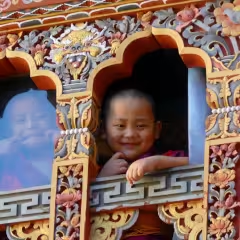
- Elaborately carved wooden windows and balconies, often painted in vivid colors.
- Sacred symbols painted or carved on walls—lotus flowers, dharma wheels, protective deities, and sometimes phallic symbols for fertility and protection.
- Religious blessing rituals at the beginning and completion of construction.
- Standalone spirit houses (lu khang) within complexes to honor unseen beings.
- Decorative talismans, such as cloth squares inscribed with prayers, hung from rafters.
- Wooden cantilever or chain bridges connecting valleys, often centuries old.
Together, these elements embody Bhutan’s philosophy of architecture as both divine offering and communal identity.
Dzongs: The Fortresses of Faith and Authority

Dzongs are the crown jewels of Bhutanese architecture: massive fortress-monasteries that historically combined spiritual, administrative and defensive functions.
Built mainly in the 17th century, dzongs served as defensive strongholds and hubs of governance. Their dual-purpose design reflects Bhutan’s unique intertwining of religion and politics.
Their sheer scale, monumental walls, and commanding locations reflect Bhutan’s history of defense, governance, and religion woven together in a single structure. Each dzong is unique, but all share certain traits: whitewashed walls, inward-sloping sides, intricately carved wooden windows, and gilded rooftops. Inside, courtyards bustle with monks, officials, and festivals, making dzongs the beating heart of Bhutanese cultural life.
Key Terms in Dzong Architecture
Several Bhutanese architectural terms are useful to know when visiting a dzong or monastery:
- Utse: the central tower that usually forms the visual and ceremonial focus of a dzong.
- Courtyard: the open internal space used for administration, gatherings and religious ceremonies.
- Lhakhang: a temple or shrine, often smaller in scale than a dzong but equally important religiously.
- Goenpa: a monastery or monastic complex, often associated with a more remote mountain setting.
- Chorten: the Bhutanese term commonly used for a Buddhist stupa.
Architectural Features
- Massive rammed-earth or stone walls.
- Central towers (utse) surrounded by courtyards.
- White exteriors with red-and-gold bands and intricately carved roofs.
- Large courtyards that host festivals and gatherings.
Punakha Dzong (Pungtang Dechen Phodrang)
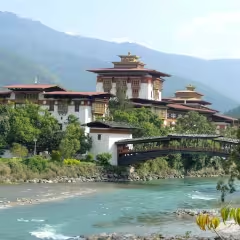
Often described as one of the finest examples of Bhutanese fortress architecture, Punakha Dzong stands at the confluence of the Pho Chhu and Mo Chhu rivers. Its towering whitewashed walls, richly decorated religious spaces, timber galleries and large courtyards make it one of the country’s most striking architectural landmarks. In spring, blooming jacaranda trees add another layer to the already dramatic composition. It is a highlight of any visit to Punakha.
Trongsa Dzong
One of Bhutan’s largest and most complex dzongs, Trongsa Dzong sprawls across a ridge above the Mangde Chhu River. Its labyrinth of temples, corridors, courtyards and staircases reflects centuries of architectural evolution. Historically, control of Trongsa was strategically important because the region commanded a major route between western and central Bhutan, giving the dzong enormous political significance.
Paro Dzong (Rinpung Dzong)
Translated as the “Fortress of the Heap of Jewels,” Paro Dzong dominates the Paro Valley with its commanding presence. Originally built in the 15th century and reconstructed in the 17th, it remains one of the best-preserved dzongs. Beyond its administrative and monastic functions, it is famous for hosting the Paro Tshechu, one of Bhutan’s most colorful festivals, where masked dances and spiritual rituals draw both locals and visitors. The dzong’s wooden cantilever bridge across the Paro Chhu is another architectural highlight.
Tashichho Dzong (Thimphu)
Serving as the seat of Bhutan’s government, Tashichho Dzong blends tradition with modern adaptation. Rebuilt in the 20th century to house ministries and the king’s offices, it also retains its monastic functions, with part of the complex dedicated to the central monk body. Its grand structure, surrounded by gardens and the Wang Chhu River, becomes especially striking at night when illuminated against the backdrop of the Thimphu hills.
Other Notable Dzongs in Bhutan
- Wangdue Phodrang Dzong – Recently reconstructed after a devastating fire, it commands views of central Bhutan’s valleys.
- Dagana Dzong – Known for its quiet majesty and proximity to remote communities, reflecting how dzongs extend governance into Bhutan’s farthest corners.
From the sacred relics of Punakha to the political symbolism of Trongsa, Bhutan’s dzongs are more than architectural feats—they are guardians of Bhutanese identity, housing the nation’s spiritual treasures and administrative authority under the same roof.
Temples and Lhakhangs: Sanctuaries of Devotion

Unlike the monumental dzongs or cliffside monasteries, Bhutan’s temples—known as lhakhangs—are usually modest in scale, blending seamlessly into villages, valleys, or hillsides.
Yet their size belies their importance: each lhakhang is a microcosm of Bhutanese spirituality, filled with symbolism, stories, and artistry. Their exteriors are typically simple—whitewashed walls capped with red ochre bands, small windows framed with wood carvings—while their interiors reveal another world entirely: gilded statues of deities, altars adorned with offerings, and vibrant frescoes depicting Buddhist cosmology.
For Bhutanese families, these temples are the heart of spiritual practice, hosting rituals, blessings, and festivals tied to the cycles of life.
Kyichu Lhakhang (Paro)
Often described as the “soul of Bhutan,” Kyichu Lhakhang is one of the country’s oldest and most revered temples. Built in the 7th century by Tibetan King Songtsen Gampo, it is said to be part of a network of 108 temples constructed in a single day to subdue a giant demoness who threatened the spread of Buddhism in the Himalayas. The temple’s serene gardens, prayer wheels, and ancient orange tree (which, legend says, bears fruit year-round) create an atmosphere of timeless peace. Pilgrims come here to circumambulate the temple and to meditate in its sacred halls, where centuries of devotion are palpable.
Jambay Lhakhang (Bumthang)
Another jewel of the 7th century, Jambay Lhakhang is equally tied to the great Songtsen Gampo’s temple network. Located in Bumthang, a region often considered the spiritual heart of Bhutan, this temple has long been a site of royal patronage and community festivals. Its most famous event is the Jambay Lhakhang Drup, a multi-day festival featuring sacred dances, including the rare naked fire dance performed at midnight to bless infertile women and drive away evil spirits. Architecturally, the temple combines simplicity with a sense of profound sanctity, making it a must-visit for those seeking Bhutan’s spiritual roots.
Chimi Lhakhang (Punakha)
Affectionately known as the Fertility Temple, Chimi Lhakhang is dedicated to the eccentric 15th-century saint Drukpa Kunley, also known as the “Divine Madman.” Unlike other lamas, Drukpa Kunley used humor, unorthodox methods, and sometimes shocking behavior to spread Buddhist teachings. Today, couples visit Chimi Lhakhang seeking blessings for fertility, and its walls are famously decorated with paintings of phalluses, symbols of protection and creativity in Bhutanese tradition. The short walk to the temple passes through beautiful rice fields, adding to its charm as both a spiritual and cultural experience.
Other Noteworthy Temples in Bhutan
- Tamzhing Lhakhang (Bumthang) – Built in the 16th century by the revered saint Pema Lingpa, this temple is rich in original murals and is still home to a monastic community.
- Changangkha Lhakhang (Thimphu) – A hilltop temple dating back to the 12th century, it is especially popular with parents who bring newborns here for blessings.
- Kurjey Lhakhang Complex (Bumthang) – Closely linked to Guru Padmasambhava, who left his body imprint on a rock here, this site is considered one of the holiest in Bhutan.
Together, Bhutan’s lhakhangs show that architectural beauty is not always in grandeur. Their quiet presence, spiritual depth, and intimate role in community life reveal another dimension of Bhutan’s architectural soul—one centered on faith, ritual, and the rhythms of daily devotion.
Monasteries: Where Spirituality Meets Landscape

Bhutan’s monasteries (lhakhangs) are not just places of worship; they are living symbols of the kingdom’s spiritual identity and its deep connection to the land. Built in dramatic locations—on cliffs, in valleys, or at the heart of villages—these monasteries embody Bhutan’s belief that sacred architecture should merge seamlessly with nature.
Paro Taktsang (Tiger’s Nest)
Arguably the most iconic site in Bhutan, the Tiger’s Nest Monastery clings to a sheer cliff 900 meters above the Paro Valley. Legend holds that Guru Padmasambhava, the founder of Vajrayana Buddhism in Bhutan, flew here on the back of a tigress to meditate in the 8th century. The complex grew around his meditation cave, creating one of the most awe-inspiring pilgrimage sites in the Himalayas. The monastery’s design—whitewashed walls, golden roofs, and wooden balconies—contrasts beautifully with the dark granite cliffs, while the steep trek to reach it adds to the spiritual experience. Inside, visitors encounter richly decorated shrines and flickering butter lamps, reminders of Bhutan’s enduring Buddhist traditions.
Gangtey Monastery (Gangtey Goenpa)
Perched on a ridge overlooking the glacial Phobjikha Valley, Gangtey Monastery is celebrated for its architectural grace and sweeping views. Built in the 17th century, it is one of the main centers of the Nyingma school of Buddhism in Bhutan. The monastery complex includes a central temple, monks’ quarters, meditation centers, and schools, making it both a spiritual and educational hub. Every November, the courtyard comes alive during the Black-Necked Crane Festival, which honors the endangered birds that migrate here each winter. The festival blends conservation awareness with cultural performances, reflecting Bhutan’s harmony between spirituality and nature.
Other Remarkable Monasteries in Bhutan
- Tango Monastery (near Thimphu) – A 13th-century site rebuilt in the 17th century, it serves as a leading Buddhist university where future spiritual leaders are trained.
- Cheri Monastery – Founded by Shabdrung Ngawang Namgyal in 1620, this monastery is revered as the place where Bhutan’s first monastic body was established.
- Kurjey Lhakhang (in Bumthang) – Built around another meditation cave of Guru Padmasambhava, it is considered one of the holiest sites in the country and a pilgrimage destination for Bhutanese kings.
From cliffside sanctuaries to valley retreats, Bhutan’s monasteries are as much about their locations as their architecture. Each one tells a story of faith, resilience, and harmony with the natural world, offering travelers unforgettable moments of beauty and reflection.
Regional Variations in Bhutanese Architecture
Bhutan does not have one completely uniform architectural style. The country’s varied geography, climate and building traditions create noticeable regional differences.
Western Bhutan
Paro, Thimphu and Punakha are particularly rich in whitewashed religious buildings, rammed-earth construction, elaborate timber details and large dzongs. Western valleys also contain many traditional farmhouses with decorated upper floors.
Central and Eastern Bhutan
Stone masonry becomes more prominent in many parts of central and eastern Bhutan, while local variations in roof construction, timber work and house proportions create a more diverse architectural landscape. Longer journeys reveal styles that are less familiar to visitors who stay on the western circuit.
Southern Bhutan
Warmer southern areas make greater use of lighter materials such as bamboo and thatch. Climate therefore has a direct influence on both materials and building form.
Chortens: Sacred Monuments of Memory

Chortens (stupas) dot the Bhutanese landscape, each a symbolic map of Buddhist cosmology:
- Base = Earth
- Dome = Water
- Spire = Fire
- Umbrella = Air
- Pinnacle = Space
Types of Chortens
- Nepalese-style: Large domes, carved ornamentation.
- Tibetan-style: Flared bases, wooden superstructures.
- Indigenous Bhutanese style: Square stone pillars topped with lunar and solar symbols.
Famous Chortens in Bhutan
- National Memorial Chorten (Thimphu): Built in memory of Bhutan’s third king.
- Dochula Pass Chortens: 108 white chortens built by the Queen Mother, set against Himalayan peaks.
- Kurjey Lhakhang Chortens (Bumthang): A wall of 108 chortens built to commemorate Guru Rinpoche.
Traditional Bhutanese Homes
Among Bhutan’s architectural treasures, the traditional Bhutanese farmhouse stands out as a timeless symbol of ingenuity and identity. Often rising two or three stories high, these farmhouses were historically built using skills and construction knowledge passed down through generations.
Their multi-tiered façades, small arched windows, and sloping shingle roofs are instantly recognizable, but beyond their beauty lies a deeply functional design: livestock below, storage in the middle, and family life with a shrine above.
More than homes, Bu houses are cultural spaces. The largest room was always the kitchen, buzzing with activity and warmth, while the shrine room reflected the spiritual heartbeat of the household. Windows were placed low so even those seated on the floor could glimpse the outside world, a detail that reveals both practicality and thoughtfulness.
Regional Variations
- Lowland homes: Bamboo and timber construction, adapted to mild climates.
- Highland homes: Stone-based construction, built to endure harsh winters.
Examples
- Gangtey Village Houses (Phobjikha): Known for elaborate woodwork.
- Bumthang Valley Houses: Featuring stone walls and ornate interiors.
Many farmhouses still showcase traditional paintings of protective deities, dharma wheels, and even phallic symbols to invite fertility and repel evil.
Bridges: Spanning Rivers with Ingenuity

Bhutan is also famous for its wooden cantilever bridges and iron chain bridges. The Tachogang Lhakhang Bridge in Paro, believed to be 600 years old, is an enduring example of Bhutanese engineering that allowed safe passage across Himalayan rivers.
Where to See the Best Bhutanese Architecture
Architecture is one of the easiest themes to weave into a Bhutan itinerary because important examples can be found in every major travel region.
- Paro: Rinpung Dzong, Kyichu Lhakhang, Dungtse Lhakhang, traditional farmhouses, bridges and Tiger’s Nest.
- Thimphu: Tashichho Dzong, Changangkha Lhakhang, monasteries and the capital’s mix of traditional and contemporary buildings.
- Punakha: Punakha Dzong, Chimi Lhakhang, Khamsum Yulley Namgyal Chorten and traditional valley architecture.
- Bumthang: Jambay Lhakhang, Kurjey Lhakhang, Tamzhing Lhakhang, Jakar Dzong and traditional houses.
- Central and eastern Bhutan: larger road journeys reveal regional variations in stone construction, temples, monasteries, dzongs and village houses.
Our guide to the best places to visit in Bhutan provides a broader geographic overview, while our destination guides go deeper into the architecture of Paro, Thimphu, Punakha and Bumthang.
Modern Bhutanese Architecture: Tradition Meets Innovation

Even in modern developments, Bhutan preserves its heritage. New constructions are required by law to reflect traditional styles, though reinforced concrete and modern materials are now used.
Examples
- Bhutan Broadcasting Service (BBS) Tower: A blend of tradition and modern technology.
- Le Meridien Thimphu: A luxury hotel combining Bhutanese motifs with contemporary comfort.
Sustainability is also central: eco-friendly building practices and strict cultural preservation policies ensure Bhutan’s skyline remains authentically Bhutanese.
7 Days in Bhutan for Architecture Lovers

For travelers drawn to Bhutan’s unique architecture, a week-long journey offers the perfect blend of sacred sites, fortress-monasteries, and traditional homes. Here’s a suggested itinerary with Travel Across Bhutan:
Day 1–2: Paro
Begin your journey in Paro with a visit to Kyichu Lhakhang, one of Bhutan’s oldest temples, where centuries of devotion resonate in its tranquil courtyards. The highlight is, of course, the Tiger’s Nest Monastery (Paro Taktsang)—a breathtaking cliffside sanctuary that embodies Bhutanese spiritual architecture at its most dramatic.
Day 3: Thimphu
Travel to Bhutan’s capital to explore Tashichho Dzong, the seat of government and the central monk body. Its grand courtyards and gilded rooftops reflect Bhutan’s ability to blend tradition with modern statehood. Nearby, visit Changangkha Lhakhang, a 12th-century temple that overlooks the city.
Day 4: Dochula Pass
On the road to Punakha, stop at the Dochula Chortens—a field of 108 white stupas set against panoramic views of the Himalayas. This site beautifully illustrates Bhutanese spiritual symbolism and its integration with the natural landscape.
Day 5: Punakha
Discover the jewel of Bhutanese architecture, Punakha Dzong. Set at the confluence of two rivers and framed by jacaranda blossoms in spring, it’s a masterpiece of fortress design and home to sacred relics. A short walk away, pay a visit to Chimi Lhakhang, the Fertility Temple dedicated to Drukpa Kunley, the Divine Madman.
Day 6: Trongsa
Journey to central Bhutan to explore Trongsa Dzong, the largest in the kingdom. Its vast network of courtyards, temples, and stairways reflects Bhutan’s political history, as every king of Bhutan has first served here as governor.
Day 7: Bumthang Valley
Conclude your architectural tour in Bumthang, often called the spiritual heart of Bhutan. Visit Jambay Lhakhang, another of Bhutan’s 7th-century temples, and explore traditional farmhouses that reveal the craftsmanship, family life, and legends embedded in Bhutanese daily architecture.
Travel Tips for Respectful Exploration
- Dress modestly when entering religious sites.
- Remove shoes before entering temples.
- Avoid loud conversation and ask permission before taking photos.
- Attend a festival (tsechu) for a living display of architecture in use.
Frequently Asked Questions About Bhutanese Architecture
What is Bhutanese architecture known for?
Bhutanese architecture is known for massive whitewashed walls, gently tapering forms, elaborate timber windows and balconies, layered roofs and richly decorated religious buildings. Dzongs, lhakhangs, monasteries and traditional farmhouses are the most recognizable examples.
What materials are used in traditional Bhutanese architecture?
Traditional buildings commonly use rammed earth, stone, timber and mud, with bamboo and thatch more common in warmer southern areas. The exact combination varies according to region, climate and building type.
What is a dzong in Bhutan?
A dzong is a large Bhutanese fortress-monastery that historically combined administrative, religious and defensive functions. Many dzongs remain important civic and monastic centers today.
What is a lhakhang?
Lhakhang generally refers to a Buddhist temple or shrine. Lhakhangs vary considerably in size, from small village temples to major historic religious complexes.
Why are Bhutanese buildings often white?
Whitewashed walls are one of the most recognizable features of Bhutanese traditional architecture, especially in important religious and institutional buildings. The white surfaces create a strong contrast with the richly decorated timber elements and colored bands.
Are Bhutanese buildings really built without nails?
Traditional Bhutanese construction is famous for its sophisticated timber joinery and its historic avoidance of nails, bolts and screws in major traditional structures. Modern construction naturally uses contemporary materials and engineering where appropriate.
Is Bhutanese architecture earthquake resistant?
Traditional techniques were developed for local conditions, but Bhutan is seismically active and traditional rammed-earth and stone buildings can be vulnerable to earthquakes. Modern conservation work therefore seeks to improve structural resilience while retaining traditional architectural character.
Where is the best place to see Bhutanese architecture?
Paro, Thimphu, Punakha and Bumthang are especially rewarding. Paro combines dzongs, temples, traditional homes and Tiger’s Nest; Thimphu shows traditional architecture alongside contemporary development; Punakha is famous for monumental religious architecture; and Bumthang is particularly rich in ancient temples and monastic heritage.
Why Travel Across Bhutan?
Travel Across Bhutan invites you to walk through fortress walls, climb to cliffside temples, and share tea in centuries-old farmhouses. Experience Bhutan’s architecture as a living story.