On November 1, 2026, Bhutan witnessed an extraordinary demonstration of faith, unity, and collective determination. In the southern town of Gelephu, approximately 40,000 volunteers came together to raise 108 Buddhist stupas in just nine hours, setting a Guinness World Record and creating one of the country’s most remarkable new spiritual landmarks.
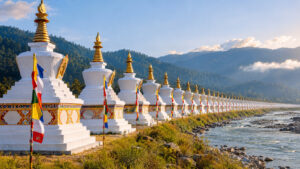
Each monument stands 15 metres tall, and together they form an almost 12-kilometre sacred corridor along the Mau Chhu River. Around 200,000 people reportedly gathered to witness this historic occasion, which brought together Bhutan’s royal family, Buddhist masters, volunteers, and pilgrims.
Known as Project 108, this royal initiative represents far more than an impressive construction achievement. It establishes a spiritual foundation for Gelephu Mindfulness City, an ambitious development that aims to combine economic progress, environmental sustainability, and Bhutan’s deeply rooted Buddhist values.
For Across Bhutan, a local travel agency dedicated to sharing the kingdom’s culture and traditions, this extraordinary event offers a fascinating insight into the role spirituality continues to play in modern Bhutan.
What Happened in Gelephu on November 1, 2026?
Before sunrise, thousands of volunteers gathered along the eastern bank of the Mau Chhu River. At approximately 3 a.m., the sound of traditional Buddhist horns marked the beginning of a coordinated effort involving 108 construction sites.
At each location, trained teams worked to assemble a Jangchub Chorten, also known as a Stupa of Enlightenment.
The scale of the operation was unprecedented:
- 108 Buddhist stupas raised simultaneously
- 15 metres in height for each monument
- 108 metres between neighbouring stupas
- Approximately 12 kilometres of sacred monuments along the river
- Around 40,000 volunteers involved in the wider initiative
- Nine hours to complete the record-setting construction and consecration
The operation required months of preparation, including land clearing, foundation construction, prefabrication of structural components, volunteer training, and religious preparations.
Rather than building the monuments entirely from scratch in nine hours, teams assembled their prepared structures simultaneously, demonstrating an exceptional level of coordination.
The achievement earned Bhutan a Guinness World Record for the highest number of stupas consecrated in a single day.
A Construction Achievement of Extraordinary Scale
To understand the scale of Project 108, imagine stacking all 108 stupas vertically.
At 15 metres each, their combined height would reach 1,620 metres, nearly twice the height of Dubai’s Burj Khalifa and almost five times the height of the Eiffel Tower.
Yet the real significance of Project 108 lies not in its comparison with famous monuments, but in the collective effort behind it.
The project brought together Bhutanese people from different generations, professions, and regions, united by a shared spiritual purpose.
Why Did Bhutan Build 108 Stupas?
The number 108 holds profound spiritual significance in Buddhism, particularly in the Vajrayana tradition practised throughout Bhutan.
It appears repeatedly in Buddhist rituals, sacred objects, and religious practices.
For example, traditional Buddhist prayer beads, known as malas, commonly contain 108 beads. Practitioners use them to count mantra recitations, prayers, and meditation cycles.
The number is also associated with overcoming mental afflictions and progressing towards spiritual awakening.
By constructing 108 stupas, Bhutan created a sacred landscape intended to encourage reflection, compassion, wisdom, and spiritual practice.
What Is a Buddhist Stupa or Chorten?
A stupa is a Buddhist religious monument associated with the teachings, enlightenment, and spiritual presence of the Buddha.
In Bhutan, stupas are commonly called chortens.
They are found throughout the kingdom, from busy towns and historic monasteries to isolated mountain passes and remote villages.
Bhutanese Buddhists traditionally walk clockwise around chortens as an act of devotion, often reciting prayers or mantras.
Many chortens contain sacred scriptures, religious objects, blessed substances, and relics.
The monuments built in Gelephu are specifically known as Jangchub Chortens, or Stupas of Enlightenment, commemorating the Buddha’s attainment of enlightenment.
Their architecture incorporates symbolic elements representing Buddhist teachings and the path towards awakening.
Why Was November 1, 2026 Chosen?
The date carried particular religious and national significance.
November 1 coincided with Lhabab Düchen, an important Buddhist festival commemorating the Buddha’s descent from the heavenly realm after teaching his mother.
The festival is widely observed in Bhutan through prayers, offerings, visits to temples, and acts of generosity.
The date also marked the anniversary of the coronation of King Jigme Khesar Namgyel Wangchuck.
By bringing these occasions together, Project 108 connected Bhutan’s Buddhist heritage, royal leadership, and aspirations for the future.
The ceremonies extended beyond the construction day, with further prayers and religious observances continuing through November 4.
The Role of Bhutan’s King and 40,000 Volunteers
Project 108 was initiated by His Majesty King Jigme Khesar Namgyel Wangchuck, who announced the vision in February 2026.
The initiative reflects a long-standing Bhutanese tradition known as zhabto, or voluntary service undertaken for the benefit of the community.
In Bhutan, communal work is not simply a practical necessity. It can also be understood as an expression of generosity, solidarity, and spiritual merit.
The volunteers participating in Project 108 represented a broad cross-section of Bhutanese society.
Some contributed to preparing the construction sites, others helped assemble the structures, while monks and Buddhist masters conducted prayers, blessings, and consecration ceremonies.
The result was a remarkable demonstration of how collective participation remains central to Bhutanese society.
Gelephu Mindfulness City: Building Bhutan’s Future on Spiritual Foundations
The 108 stupas are closely connected to one of Bhutan’s most ambitious development initiatives: Gelephu Mindfulness City (GMC).
Located in southern Bhutan near the Indian border, Gelephu is being developed as a new economic and urban centre intended to create opportunities for future generations.
The project seeks to attract investment and expertise in sectors such as sustainable tourism, education, technology, healthcare, and financial services.
However, Gelephu Mindfulness City is not envisioned as a conventional modern metropolis.
Its guiding philosophy is to combine economic growth with environmental responsibility, cultural preservation, and human well-being.
The construction of 108 Buddhist stupas establishes a visible spiritual identity for the future city.
Rather than treating Buddhist traditions as remnants of the past, the project places them at the centre of Bhutan’s vision for development.
Related reading: Discover our dedicated article to Gelephu Mindfulness City to learn more about the project, its ambitions, and its potential impact on Bhutan’s future.
Can Travelers Visit the 108 Stupas in Gelephu?
The new chortens create a remarkable cultural and spiritual landmark in southern Bhutan.
Their alignment along the Mau Chhu River offers a distinctive setting for visitors interested in Buddhist architecture, contemporary Bhutanese history, and the country’s evolving cultural landscape.
However, travelers should remember that these monuments are sacred religious structures, not simply tourist attractions.
Visitors should approach them respectfully, follow any local access restrictions, and observe appropriate Buddhist etiquette.
As Gelephu Mindfulness City continues to develop, public access, visitor facilities, and tourism arrangements may change. Travelers should confirm the latest conditions before planning a visit.
Discover Bhutan’s Buddhist Heritage Beyond Gelephu
Although Project 108 is a new landmark, chortens have been part of Bhutan’s religious landscape for centuries.
Travelers can encounter beautiful examples throughout the country, including:
- Dochula Pass: Famous for its 108 memorial chortens overlooking the Himalayan mountains.
- Punakha: Home to important Buddhist temples, monasteries, and religious monuments.
- Thimphu: Where the National Memorial Chorten is one of the capital’s most important places of worship.
- Paro: Known for its sacred temples and the iconic Tiger’s Nest Monastery.
These destinations help visitors understand the continuity between Bhutan’s ancient spiritual traditions and contemporary initiatives such as Project 108.
A New Wonder of the World?
Bhutanese media have described the construction of the 108 stupas as a potential new wonder of the world.
While this is an expression of admiration rather than an official designation, the achievement is undeniably exceptional.
Few modern religious projects have brought together so many people to construct and consecrate so many monuments simultaneously.
The Guinness World Record confirms the unprecedented nature of the undertaking.
More importantly, Project 108 illustrates something that makes Bhutan distinctive: its determination to preserve spiritual traditions while embracing economic and social change.
For the people of Bhutan, the monuments represent a shared offering, a symbol of national unity, and a lasting reminder of what collective effort can accomplish.
Frequently Asked Questions About Bhutan’s 108 Stupas
Where are the 108 new stupas located in Bhutan?
The 108 Jangchub Chortens are located along the Mau Chhu River in Gelephu, southern Bhutan, near the Indian border. They form an approximately 12-kilometre sacred corridor associated with Gelephu Mindfulness City.
When were the 108 stupas built?
The monuments were raised on November 1, 2026, during a coordinated construction event involving thousands of volunteers. Their foundations and structural components had been prepared in advance.
How long did it take to build the 108 stupas?
The record-setting assembly and consecration were completed in approximately nine hours. The wider project required months of planning, preparation, and construction work.
How tall are the stupas in Gelephu?
Each Jangchub Chorten stands approximately 15 metres tall. Together, the 108 monuments represent a combined vertical height of 1,620 metres.
Why is the number 108 sacred in Buddhism?
The number 108 is associated with Buddhist spiritual practice, including mantra recitation, prayer beads, and the overcoming of mental afflictions. It carries particular significance in Vajrayana Buddhist traditions.
Is Project 108 part of Gelephu Mindfulness City?
Yes. Project 108 is a royal initiative that establishes a spiritual landmark for Gelephu Mindfulness City, connecting the future urban development with Bhutan’s Buddhist heritage.
Did Bhutan set a Guinness World Record?
Yes. The construction and consecration of 108 stupas on November 1, 2026, earned recognition for the highest number of stupas consecrated in a single day.
Discover the Spiritual Heart of Bhutan With Across Bhutan
Project 108 is a powerful reminder that Bhutan’s Buddhist traditions remain deeply connected to everyday life, community values, and the kingdom’s vision for the future.
From ancient monasteries and sacred mountain passes to extraordinary new landmarks such as the stupas of Gelephu, Bhutan offers travelers countless opportunities to discover a culture shaped by spirituality.
At Across Bhutan, our local team creates tailor-made journeys that combine cultural discovery, authentic encounters, spectacular landscapes, and meaningful experiences.
Whether you wish to explore Bhutan’s most famous monasteries, discover lesser-known regions, or learn more about its living Buddhist traditions, we can help you design a journey that reflects your interests.
Plan Your Custom Tour or Contact Our Team to start planning your Bhutan adventure.